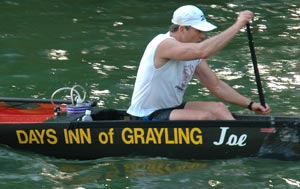
Tips from Joe Shaw
hope Ray Fusco knows that this "pro" has done only one surf ski race! I have however been racing canoes and kayaks for 25+ years and have always preferred the longer, 3+ hour races. To some extent I look at all distances; from sprint to ultra-marathon; and all boat types; ICF kayak, surf ski, pro canoe, dragon boat, swan boat, and outrigger canoe as just one more opportunity to have fun on the water with good friends. I encourage everyone to experiment with different aspects of paddle sports.
Here are highlights of a few topics I cover in racing clinics and places to go for more detailed information.
Remembering my first long race (70 miles) I started preparing by making sure I could last that distance. The bulk of your training time should be spent building a solid endurance base by logging long work outs at an easy intensity -- 60 to 70% of maximum heart rate. This is a great time to work on technique. Experienced racers agree that no amount of conditioning will make up for poor technique. Try to concentrate on a few key components of your stroke each time out. "The Kayak Forward Stroke" DVD available from Epic Kayaks is a great starting point to learn efficient technique. If you are trying something new with your technique be prepared for it to feel awkward at first - give it time! One of the things I like to work on during my long paddles is relaxed paddling. I scan my body and see if I can relax muscles I donft need for paddling. It is amazing how much energy you can save and improve your balance at the same time.
Your long training days are also an excellent time to work out your drinking and eating requirements. This may sound obvious but work out these details in advance - both the mechanics of how to carry your supplies as well as what you will consume. Stick to the basics and always try drinks and/or foods in practice. I like to have a high carbohydrate meal 3 hours before the race and plan on consuming 500 - 750 liters of an energy/electrolyte drink per hour during the event.
After you have established a solid aerobic base of 20 to 30 hours it is time to develop speed by adding some higher intensity interval work outs to your program. My early season speed sessions consist of longer (5 - 8 minute) work periods at a heart rate of 85% to 90% of max heart rate. Rest periods may be up to half the work period. Total "work time" is 30-40 minutes. I will do these twice a week; once if I am racing on the weekend. Later in the season I will add 15 second to 2 minute intervals at heart rates of 90 to 95% of max. Aside from the two hard sessions a week the remainder of my training is at a very easy (60 -70%) pace. Avoid middle intensity sessions - if you don't go easy enough on your easy days you will not be physically or mentally able to go hard enough on your hard days.
I am a firm believer in using heart rate monitors to assist in planning and monitoring your training sessions. Although written for cross country ski racers I think the article available at his link provides the most concise and complete training plan I have seen. The
article will explain intensity and frequency of speed building work outs. "The Barton Mold", now available as a free download from the Epic Kayak website is also an invaluable resource of training information.
Finally do not forget rest and injury prevention! Your body gets stronger while you are resting not during a hard work out. Never forget warm ups, cool downs, stretching or yoga as part of your routine. Don't forget to taper before a major race. Rather than trying to get in that last long or hard work out concentrate on rest and recovery during the week before a long and challenging event like the Mayor's Cup.