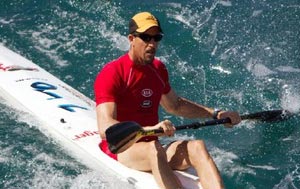
Tips from Joe Glickman
Rough Water Paddling
Day One of a month-long kayak stage race from Chicago to New York: a 33-mile paddle across Lake Michigan. With 20-knot winds and erratic three-to-six foot waves, the lake was transformed into a washing machine gone mad. I'd only been paddling about a year, and I swam so much that day you'd think I was in a multi-sport event. Moments after stumbling out of my narrow sit-on-top kayak at the finish, I turned to stage winner Dean Gardiner, a lifeguard and boat skipper from Sydney, Australia, and said: "The waves were wild out there!"
The word "waves" seemed to surprise the reigning World Surf Ski Champion. "Just a bit of chop, mate," he said matter-of-factly.
"Screw you," I said in my best Brooklynese. "Where I come from those are waves."
Therein lies the difference between a true waterman who grew up paddling in a non-peaceful section of the Pacific called "the Valley of the Giants" and those of us who train in Brooklyn's (mostly) tranquil Jamaica Bay.
Fast-forward five years and countless kayaking hours later, to Expedition BVI, a four-day stage adventure race in the British Virgin Islands that featured as much as 60% paddling. After a bumpy inter-island crossing in stable, two-person plastic sit-on-tops, I overhead a fellow competitor lamenting that the sea was "nine feet". In fact, it was two-to-four foot chop. Chuckling, I thought back to Gardiner's comment and noted how skill and experience inform our perception.
Regardless, the majority of adventure racers, even those who have logged copious boat time, struggle in the rough stuff. One reason is that water conditions vary so greatly from venue to venue--even from hour to hour, depending on winds and tides. But, fret not. There are tactics that will help you be more relaxed and perform better even in truly gnarly water.
This May, I was in Hawaii for the 27th annual Molokai World Championship, a 32-mile surf ski race from the island of Molokai to Oahu across one of the roughest channels in the world. Unlike a conventional kayak that you sit inside, you sit on top of a surf ski. The racing models are fast, maneuverable and tippy -- roughly 20-feet long by 18-inches wide -- and designed to surf ocean swells. If you fall off one of these sleek craft, it's relatively easy to climb back on and paddle off. This year, the field included 60 men and women from Australia, South Africa, Tahiti, Japan, New Zealand, Hawaii and the mainland, the greatest collection of talent ever assembled for the biggest open ocean racing event of the year. Only five men have won the race in its long history, and four were in attendance.
I arrived fit and ready to rumble. But five days before the race, the trade winds were blowing 20 miles or more, and during my training sessions along the cliffs on Oahu's east side I wobbled like a drunk in heels in turbulent six-to-12 feet seas. Seeking guidance from the two of the greatest ocean paddlers of all time, I sat down with South African Oscar Chalupsky and Aussie Dean Gardiner. Gardiner, who holds the Molokai course record of 3 hours and 21 minutes, and Chalupsky, a 1992 Olympian, started the race with nine World Championships each: this was to be their rubber match.
Here are their top five tips to help us mere mortals in times of aquatic stress:
•
Don't hold on to your paddle as if your life depended on it."Your hands are an extension of your body," says the 40-year-old from Durban. "If your body is stiff your balance is compromised. The key is to relax your body; move with the water, not against it. When in Hawaii, make like a hula dancer and roll your hips with the bumps."
•
Spend time in rough water.Says Gardiner: "Experience is the best teacher of all. When the wind is blowing, force yourself to go out and get used to chop. Make sure you go with a partner, tether your paddle to your boat and paddle along the coast in case you flip. This will allow you to gain experience in rough conditions with a minimum of risk. A typical training session in Sydney, a bunch of us paddle into the wind at a moderate pace for 10 minutes and then turn downwind and chase the runs back to the beach. This helps you learn the nuances of rough water and get more comfortable as the session goes along." [For more training tips, go to
www.surfski.co.nz]
•
Rely on your technique."At the end of the day," says Chalupsky, "your technique will see you through the difficult conditions. The rougher the sea, the more you must concentrate on your style. Make sure you sit up straight. While you still want to concentrate on proper shoulder rotation, dropping your hands will lower your center of gravity and improve your balance. In addition, make sure you use to legs to keep yourself firmly in the kayak and to transfer your power into the boat. The key is to not let your speed drop off. The slower you go the less stable you are." [For more on technique, go to
www.epickayaks.com to check out the video by Chalupsky and four-time Olympic medallist Greg Barton.]
•
Surf straight down a wave."Too many beginners," says Gardiner, "try and surf across a wave. The key is to take off perpendicular to a wave and drop straight down the face. Once you have the speed you can track across the wave and look for another run. Always try and keep your bow pointed down. To do that, scan the sea for holes in front of you and paddle towards them."
•
Never lose sight of the finish."There's a tendency," says Chalupsky, to go way off course when you're chasing the runs. Beware at all times of your final destination. This doesn't mean you have to track a straight line. You don't. But you need to keep your speed up and turn towards your destination while you're using the speed of the wave. That sounds simple but it's easy to lose sight of where you're going."
At the start of the race, Gardiner and Chalupsky disappeared out in front in less than four minutes, surfing the eight-to-12 foot seas in sleek 19-foot kayaks like skiers carving mogul turns. Gardiner led all the way across the channel until the 6-foot, 4-inch, 240-pound South African ground him down to notch his record 10th title (in 11 tries) in 3 hours, 28 minutes and 33 seconds, one minute ahead of his rival. As for me? I finished 29th, and felt pretty good about it.